Blog Hero

How Regular Comprehensive Eye Exams Help Seniors Manage and Prevent Age-Related Macular Degeneration

Schedule an Appointment
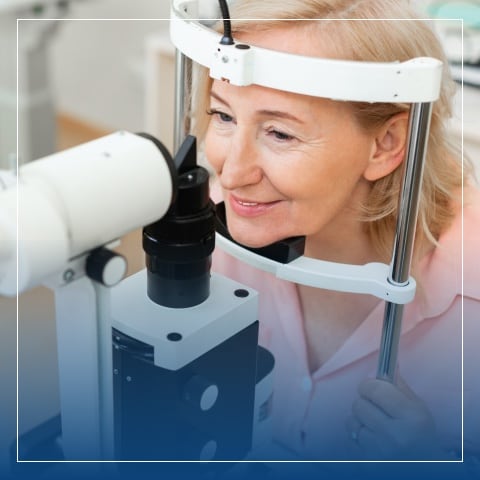
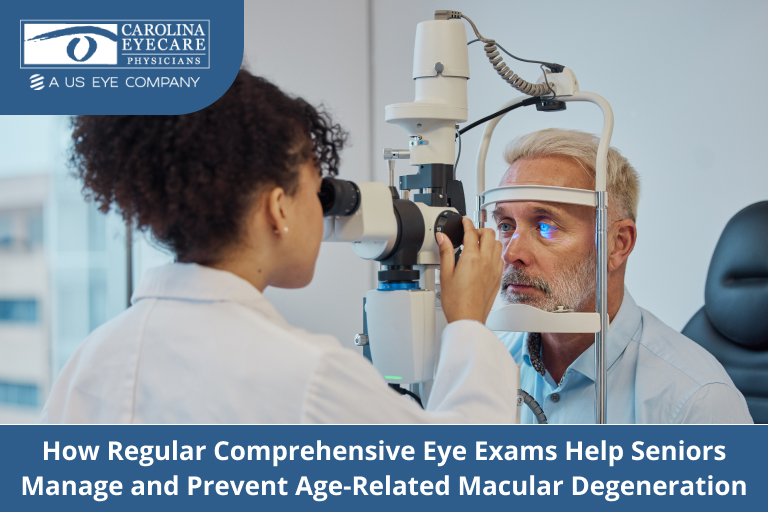
Senior patient receiving a comprehensive eye exam at Carolina Eyecare Physicians to screen for age-related macular degeneration (AMD) in South Carolina

Reviewed By: Dr. Brugger

Age-related macular degeneration (AMD) remains the primary cause of vision loss in adults over sixty. The condition often advances without pain or early warning signs, so the most reliable way to safeguard central vision is a schedule of consistent, adult eye exams and, for anyone living with diabetes, regular diabetic eye exams as well. These visits allow eyecare specialists to spot subtle macular changes long before reading, driving, or recognizing faces becomes difficult.

Why AMD Requires Vigilance in Senior Eye Care

AMD targets the macula, the small retinal zone that delivers sharp, detailed sight. Dry AMD progresses gradually, while wet AMD can damage vision in a matter of weeks, yet both forms can begin without noticeable symptoms. Individuals who keep pace with routine eye exams for seniors give their doctors a chance to find the earliest hints of trouble, such as early-stage Charleston dry macular degeneration, often years ahead of daily-life impact. That early knowledge opens the door to nutrition counselling, lifestyle adjustments, or sight-saving injections before irreversible loss occurs.

What a Comprehensive or Diabetic Eye Exam Looks Like

A full evaluation covers far more than an updated glasses prescription. After reviewing medical history and current medications, the doctor widens the pupils with dilating drops and studies the macula through a binocular microscope. Optical coherence tomography then produces cross-section images of retinal layers, revealing microscopic swelling or thinning that would otherwise stay hidden. High-resolution fundus photographs create a baseline for future comparison, and a brief Amsler-grid check helps uncover any distortion in central vision. 

Patients who schedule a dedicated diabetic retinopathy exam receive these same tests plus a careful search for leaking blood vessels that raise the risk of both retinopathy and AMD.

Early Detection Leads to Practical Protection

Catching AMD in its mild or intermediate stage gives patients time to act. Many begin the AREDS2 supplement plan—a blend of vitamins C and E, zinc, copper, lutein, and zeaxanthin—shown to slow progression in appropriate candidates. Doctors also review everyday habits, encouraging tobacco cessation, ultraviolet protection, balanced blood pressure, and a leafy-green diet to support retinal health. If dry AMD converts to the wet form, as seen in South Carolina wet macular degeneration, prompt anti-VEGF injections can stabilize sight that might otherwise fade quickly.

How Often Should Seniors Schedule an Exam?

The American Academy of Ophthalmology advises adults over sixty-five to book a comprehensive exam every one to two years. Anyone with a family history of AMD, a history of smoking, high blood pressure, extensive lifetime sun exposure, or diabetes should plan on yearly visits, particularly if they are at risk for conditions like South Carolina dry macular degeneration. People managing diabetes benefit from even closer monitoring through routine diabetic eye care, because vascular changes can intensify other retinal disorders.

Turning Exam Results Into a Clear-Sighted Plan

A thorough appointment ends with a conversation, not just a report. If the doctor sees early drusen deposits or fluid pockets, particularly in cases of Charleston dry macular degeneration, the next steps might include nutritional counselling, monthly Amsler-grid self-checks at home, or an accelerated recall schedule. In cases where wet AMD, such as South Carolina wet macular degeneration, is confirmed, the practice arranges timely treatment so that reading vision and face recognition stay as sharp as possible.

Protect Your Vision With Carolina Eyecare Physicians

AMD does not have to erase independence. Regular, comprehensive care—whether an annual adult eye exam or a tailored diabetic eye exam—lets you stay ahead of change and enjoy clear sight far into the future. 

If it’s been more than twelve months since your last visit, or if you’ve noticed new blur or waviness, contact Carolina Eyecare Physicians today to arrange an appointment. Early action is the simplest, most effective step in preserving vision for the years ahead.


Written by useye

More Articles By useye

Locations

We have several convenient locations throughout South Carolina. Please view the nearest location to you or get directions below. 

    News

    Cloudy Vision in One or Both Eyes: When Should You See an Eye Doctor?

    Cataract Surgery, Laser Cataract Surgery

    Reviewed By: Dr. John G. P. Boatwright Summary Cloudy vision can make your vision seem hazy, milky, or foggy. Sometimes it develops gradually and points to a condition like cataracts. Other times, especially when it appears suddenly, it can signal a more urgent problem that needs prompt medical attention. This guide explains common causes of […]

    Read More… from Cloudy Vision in One or Both Eyes: When Should You See an Eye Doctor?

    June 12, 2026
    useye

    Dr. Kerry Solomon Delivers Prestigious ASCRS Binkhorst Lecture on the Future of AI in Ophthalmology

    News & Updates

    Carolina Eyecare Physicians is proud to recognize Kerry D. Solomon, MD, Chief Medical Officer of US Eye and Medical Director of Carolina Eyecare Physicians, for being selected to deliver the prestigious ASCRS Binkhorst Lecture on April 11, 2026; a distinction considered one of the most significant career honors in ophthalmology. The Binkhorst Lecture is among […]

    Read More… from Dr. Kerry Solomon Delivers Prestigious ASCRS Binkhorst Lecture on the Future of AI in Ophthalmology

    May 14, 2026
    useye

    PRK vs LASIK: Which Eye Surgery Is Safer for You?

    Eye Surgery

    Reviewed By: Cole Milliken, MD Summary Choosing laser vision correction usually comes down to two well-known options: PRK and LASIK. Both procedures are designed to reduce dependence on glasses, routine contact lens exams, or daily contact lens wear by reshaping the cornea, and both have strong long-term outcomes for the right patient. The difference is […]

    Read More… from PRK vs LASIK: Which Eye Surgery Is Safer for You?

    May 11, 2026
    useye
    Cloudy Vision in One or Both Eyes_ When Should You See an Eye

    Reviewed By: Dr. John G. P. Boatwright Summary Cloudy vision can make your vision seem hazy, milky, or foggy. Sometimes it develops gradually and points to a condition like cataracts. Other times, especially when it appears suddenly, it can signal a more urgent problem that needs prompt medical attention. This guide explains common causes of […]

    Read More… from Cloudy Vision in One or Both Eyes: When Should You See an Eye Doctor?

    Dr. Kerry Solomon, Medical Director of Carolina Eyecare Physicians, delivering the ASCRS Binkhorst Lecture on AI in Ophthalmology.

    Carolina Eyecare Physicians is proud to recognize Kerry D. Solomon, MD, Chief Medical Officer of US Eye and Medical Director of Carolina Eyecare Physicians, for being selected to deliver the prestigious ASCRS Binkhorst Lecture on April 11, 2026; a distinction considered one of the most significant career honors in ophthalmology. The Binkhorst Lecture is among […]

    Read More… from Dr. Kerry Solomon Delivers Prestigious ASCRS Binkhorst Lecture on the Future of AI in Ophthalmology

    PRK vs LASIK eye surgery procedure

    Reviewed By: Cole Milliken, MD Summary Choosing laser vision correction usually comes down to two well-known options: PRK and LASIK. Both procedures are designed to reduce dependence on glasses, routine contact lens exams, or daily contact lens wear by reshaping the cornea, and both have strong long-term outcomes for the right patient. The difference is […]

    Read More… from PRK vs LASIK: Which Eye Surgery Is Safer for You?

    Carolina Eyecare Physicians Partner Background Image
    US Eye Logo

    We are a proud partner of US Eye, a leading group of patient-centric, vertically integrated multi-specialty physician practices providing patients with care in ophthalmology, optometry, dermatology, audiology, and cosmetic facial surgery.

    instagram facebook facebook2 pinterest twitter google-plus google linkedin2 yelp youtube phone location calendar share2 link star-full star star-half chevron-right chevron-left chevron-down chevron-up envelope fax