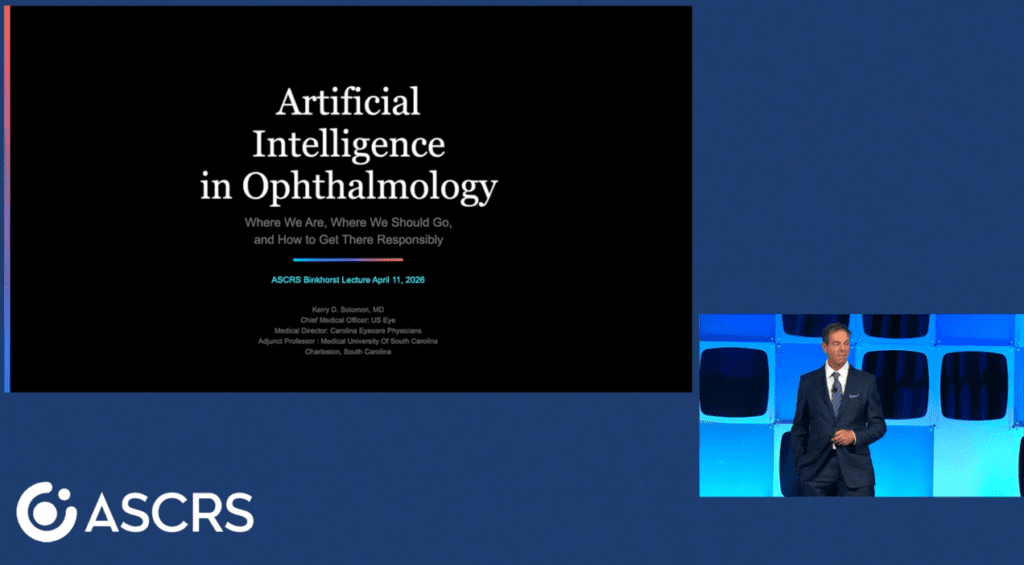
Carolina Eyecare Physicians is proud to recognize Kerry D. Solomon, MD, Chief Medical Officer of US Eye and Medical Director of Carolina Eyecare Physicians, for being selected to deliver the prestigious ASCRS Binkhorst Lecture on April 11, 2026; a distinction considered one of the most significant career honors in ophthalmology.
The Binkhorst Lecture is among the most highly regarded recognitions in cataract and refractive surgery, reserved for physicians whose careers have demonstrated exceptional leadership, innovation, and lasting contributions to the field. Being selected to deliver this lecture places Dr. Solomon among a highly respected group of ophthalmologists whose work has helped influence the direction of modern eye care.
Dr. Solomon’s presentation, titled “Artificial Intelligence in Ophthalmology: Where We Are, Where We Should Go, and How to Get There Responsibly,” explored how artificial intelligence is beginning to reshape eye care, clinical workflow, surgical planning, documentation, and the future of ophthalmology.
In the lecture, Dr. Solomon discussed the growing role of AI in medicine and emphasized that ophthalmology is uniquely positioned to benefit from these advances. From clinical documentation and patient communication to diagnostics, surgical decision-making, and robotic-assisted procedures, AI has the potential to improve efficiency while allowing physicians to remain more present with their patients.
One key area highlighted in the presentation was the use of ambient AI technology for clinical documentation. Dr. Solomon discussed how tools such as AI-powered scribes can capture patient encounters in real time, reduce typing and administrative burden, and allow physicians to focus more fully on the patient conversation. In the lecture, he noted the potential for these tools to save significant time during the clinic day while decreasing after-hours charting.
Dr. Solomon also addressed the future of AI-assisted and robotic surgery, explaining that the next major breakthrough may not simply be hardware, but the intelligence and software that guide it. His presentation framed robotic surgery as part of a larger evolution in ophthalmology, where data, imaging, machine learning, and surgeon expertise may work together to support greater precision and consistency.
Throughout the lecture, Dr. Solomon emphasized that AI must be adopted responsibly. He encouraged the ophthalmology community to think carefully about how these tools are implemented, how patient trust is protected, and how physicians can use technology to enhance—not replace—the human connection at the center of medical care.
“Artificial intelligence is not about removing the physician from the equation,” said Dr. Solomon. “It is about giving physicians better tools, better information, and more time to focus on what matters most: the patient.”
For Carolina Eyecare Physicians, Dr. Solomon’s national presentation reflects the practice’s continued commitment to innovation, research, and forward-thinking patient care. As new technologies emerge, Carolina Eyecare Physicians remains focused on evaluating advancements that may improve outcomes, streamline care, and support a better experience for patients and providers alike.
Dr. Solomon’s lecture also offered a personal perspective on the future of medicine, underscoring that technology should ultimately serve people. By combining clinical experience, research, and responsible innovation, he encouraged physicians to help guide AI in a direction that strengthens patient care and preserves the values that define the physician-patient relationship.