Reviewed By: Dr. Peter B. Knowlton
Table of Contents
Summary
Cataract eye surgery replaces the eye’s cloudy natural lens with an artificial intraocular lens, or IOL. Available options include monofocal lenses, toric correction for astigmatism, multifocal or trifocal lenses, extended depth-of-focus lenses, and the Light Adjustable Lens. The right choice depends on your eye health, visual priorities, comfort with glasses, and how you use your vision every day.
Choosing an IOL is one of the most important parts of cataract surgery planning. The lens placed during surgery helps determine where your vision will be focused afterward, so the decision goes beyond simply removing the cataract.
No single IOL is best for every patient. Someone who drives frequently at night may have different priorities from someone who wants to read or use a computer with less dependence on glasses. Your surgeon will use detailed measurements and an evaluation of your eye health to narrow the options and explain which tradeoffs matter for you.
What Is an Intraocular Lens?
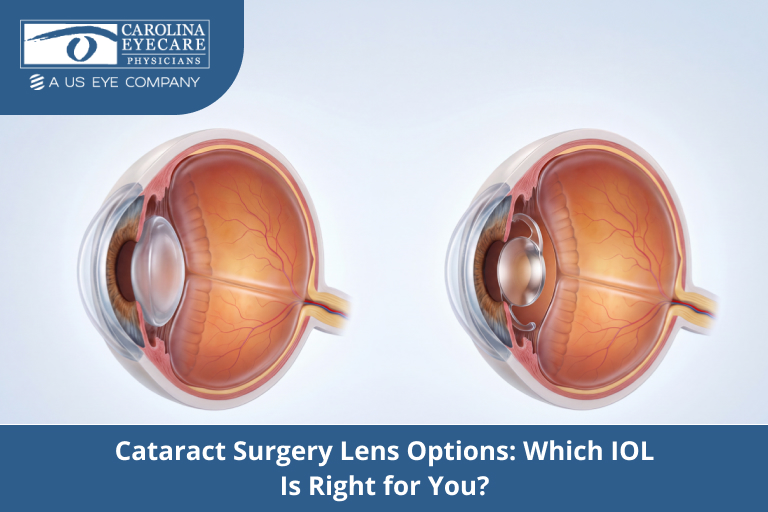
An intraocular lens is a small artificial lens implanted after the cloudy natural lens is removed during cataract surgery. Like the natural lens, an IOL focuses light onto the retina so the eye can form a clear image.
Different lens designs provide different focusing capabilities. Some offer one primary focal point, while others are designed to provide useful vision across a broader range of distances. Modern IOL options can also address astigmatism or, in certain cases, allow the prescription to be adjusted after surgery.
What Are the Main Cataract Surgery Lens Options?
Understanding the differences between lens designs makes it easier to decide what you want from your vision after cataract surgery.
Monofocal IOLs
A monofocal IOL provides one primary focal point. Many patients choose to target distance vision and use reading glasses for close work, although the lens can be targeted differently depending on individual goals.
Monofocal lenses have a long history of use and generally produce fewer halos and other nighttime visual effects than multifocal designs. That can appeal to patients who are comfortable using glasses for some activities or who prioritize night vision.
Toric IOLs for Astigmatism
Toric IOLs are designed to correct regular corneal astigmatism. Toric correction can be incorporated into different types of lens designs rather than functioning as an entirely separate category of vision.
For someone with meaningful astigmatism, correcting it during cataract surgery may improve uncorrected vision afterward. Preoperative measurements help determine whether toric correction is appropriate and how much correction is needed.
Multifocal and Trifocal IOLs
Multifocal and trifocal lenses are designed to provide useful vision at more than one distance. Depending on the specific lens, that may include near, intermediate, and distance vision.
These lenses can reduce dependence on glasses for many everyday activities. They can also produce halos, glare, or other visual effects, particularly around lights at night. The likelihood and significance of these effects vary by patient and lens design.
Extended Depth-of-Focus IOLs
Extended depth-of-focus, or EDOF, lenses provide an elongated range of focus. They are generally designed to provide strong distance and intermediate vision, which can help with driving, computer work, dashboards, and similar activities.
Patients may still need reading glasses for smaller print or close detail. EDOF lenses can also create nighttime visual effects, so discuss expectations before surgery.
Light Adjustable Lens
The Light Adjustable Lens, or LAL, offers a different approach. Its focusing power can be adjusted after cataract surgery using a series of controlled light treatments once the eye has begun to heal. The FDA approved the technology for postoperative refractive adjustment in qualifying cataract patients.
Carolina Eyecare Physicians offers the LAL as one of its advanced cataract surgery options. Patients must attend the required adjustment visits and wear the prescribed UV-protective glasses until treatment is complete.
For more detail on how this technology works, read our guide to Light Adjustable Lenses after cataract surgery.
Cataract Surgery Lens Options at a Glance
| Lens Type | Designed For | Things to Consider |
|---|---|---|
| Monofocal IOL | Clear vision at one primary distance | Reading glasses may still be needed; often fewer halos and nighttime visual effects |
| Toric IOL | Correcting astigmatism during cataract surgery | Requires precise measurements and is based on your level of astigmatism |
| Multifocal/Trifocal IOL | Providing vision across near, intermediate, and distance ranges | May reduce glasses dependence but can cause halos or glare for some patients |
| EDOF IOL | Extending the range of clear vision, especially distance and intermediate | Reading glasses may still be needed for small print or close work |
| Light Adjustable Lens (LAL) | Custom vision adjustments after surgery | Requires additional adjustment visits and specific post-treatment care |
Premium Lens Implants vs. Standard IOLs
A standard monofocal IOL provides one primary focal point and is typically the conventional lens used with medically necessary cataract surgery.
Premium or advanced options may provide additional functionality, such as astigmatism correction, a broader range of focus, or postoperative adjustability. Those features may reduce dependence on glasses, but they also add considerations around cost, visual side effects, and candidacy.
For some patients, a monofocal IOL provides the exact vision they want. Others may decide that reducing their need for glasses makes an advanced lens worth considering.
Medicare generally covers a conventional IOL as part of medically necessary cataract surgery. Patients who choose presbyopia-correcting or astigmatism-correcting functionality may be responsible for the additional costs associated with those features. Commercial insurance coverage varies.
How Do You Choose the Right IOL for Cataract Eye Surgery?
Lens selection starts with what your eyes can support and what you want your vision to do after surgery.
Consider Your Eye Health
The cornea, retina, optic nerve, and eye surface all affect visual quality after cataract surgery. Macular disease, glaucoma, corneal irregularities, previous eye surgery, or significant dry eye may influence which IOL designs are appropriate.
Dry eye can be particularly important during planning because an unstable tear film may affect the measurements used to calculate IOL power. Treating the ocular surface before final measurements can help improve the accuracy of surgical planning.
Think About Your Daily Vision
Your surgeon needs to know which activities matter most to you.
Consider how much time you spend driving at night, using a computer, reading, working at close range, or participating in hobbies that require precise vision. Someone who wants strong distance vision with minimal nighttime effects may choose differently from someone whose main goal is reducing dependence on reading glasses.
Tip: Before your cataract consultation, identify a few activities you most want to perform without glasses. Specific examples give your surgeon a clearer picture of your visual priorities.
Understand the Tradeoffs
Every IOL has strengths and limitations.
A monofocal lens may offer excellent vision at its targeted distance while leaving you dependent on glasses for other distances. Multifocal, trifocal, and EDOF technologies can broaden the usable range of vision but may introduce visual effects that some patients notice more than others.
The goal of the consultation is to determine which tradeoffs fit your eyes and your expectations.
Carolina Eyecare outlines its cataract surgery and advanced vision options for patients who want to learn more before their evaluation.
Key Takeaways
- Cataract eye surgery replaces the cloudy natural lens with an artificial IOL.
- Monofocal lenses provide one primary focal point and remain a strong option for many patients.
- Toric correction can address regular corneal astigmatism.
- Multifocal, trifocal, and EDOF lenses can provide a broader range of useful vision but may involve visual tradeoffs.
- The Light Adjustable Lens allows refractive adjustments after surgery for qualifying patients.
- Eye health, lifestyle, glasses preferences, and cost should all factor into the decision.
Finding the Lens That Fits Your Vision
Choosing an IOL requires balancing what your eyes can support with the way you want to use your vision after surgery. For one patient, that may mean dependable distance vision with reading glasses nearby. For another, reducing dependence on glasses across several distances may matter more.
A cataract evaluation provides the measurements and eye-health information needed to narrow the choices. It also gives you an opportunity to discuss night driving, close work, previous eye procedures, and other priorities before selecting a lens.
Explore Cataract Surgery Options at Carolina Eyecare Physicians
Carolina Eyecare Physicians offers conventional and advanced cataract surgery options, including astigmatism treatment and the Light Adjustable Lens in select markets. Our surgeons evaluate each patient’s eye health and visual goals before recommending an IOL.
Schedule a consultation with Carolina Eyecare Physicians to discuss your cataract surgery lens options and determine which approach suits your lifestyle best!
Frequently Asked Questions
Does Previous LASIK Affect Which IOL I Can Choose?
It can affect surgical planning because LASIK changes the shape of the cornea, which can make IOL power calculations more complex. Surgeons can use additional measurements and calculation methods for patients who have had previous refractive surgery. The Light Adjustable Lens may also be considered for some patients with previous corneal surgery.
Can the IOL Be Changed After Cataract Surgery?
An IOL can sometimes be repositioned or exchanged when a significant medical or visual issue develops. Lens exchange requires another procedure, however, so careful selection before the original surgery remains important.
How Does My Surgeon Calculate the IOL Power?
Measurements taken before surgery help determine the IOL power needed to reach the intended vision target. Factors such as the length of the eye, corneal shape, astigmatism, previous refractive surgery, and ocular surface quality can influence the calculation.
Do Both Eyes Have to Be Focused the Same Way?
No. Some patients use monovision or mini-monovision, where the two eyes are targeted differently to provide a broader functional range. This approach works well for some people and poorly for others, so previous experience with monovision or a trial may help guide the decision.