Reviewed By: Kerry D. Solomon, MD
You’ve heard of glasses and contact lenses, but what is an artificial or intraocular lens?
Ophthalmic technology continues to advance, allowing doctors to provide patients with innovative and advanced treatment options. An artificial intraocular lens, or IOL, is a great example of this—a continually developing tool that allows people to see more clearly and comfortably.
To understand IOLs, we’ve compiled the information here on our blog.
Table of Contents
Understanding Intraocular Lenses
Inside your eye, behind your iris, is a natural biconvex lens. This natural lens refracts (bends) light entering your eye and focuses it on your retina. This function is what allows us to see.
The natural lens should be clear in order for all light to pass through to your retina. However, if the lens becomes cloudy or hazy, it can cause discolored vision, blind spots, or partial vision loss. This condition is known as cataracts.
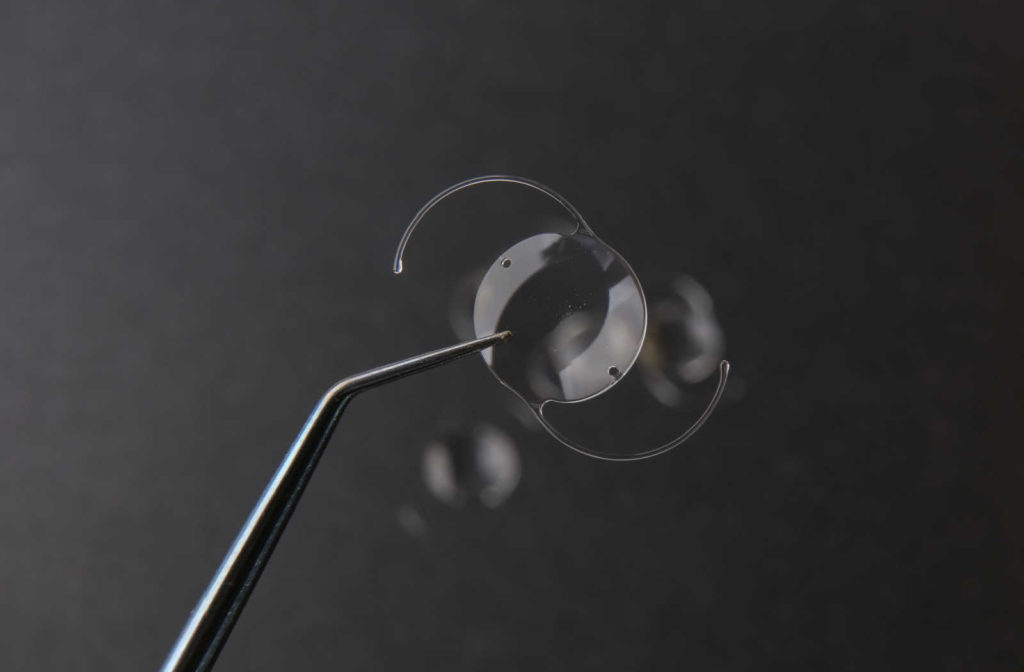
An intraocular lens (IOL) is an artificial lens for the eye. An IOL is designed to replace the natural lens of your eye and is implanted during surgery. Most IOLs, including an artificial lens for cataract surgery, are made of silicone, acrylic, or another plastic composite.
While these lenses were originally designed to treat cataracts, IOLs also come in a variety of focusing powers. Like prescription eyeglasses or contact lenses, you can get an IOL with your prescription so that you can see clearly.
Your ophthalmologist can measure the length of your eye and the curve of your cornea to ensure the intraocular lens implant for vision correction is customized to your needs. It’s important to get these measurements because the prescription isn’t accommodating for the same distance as glasses or contacts.
IOLs can be made with a UV protective coating, as well, to protect your eyes from harmful ultraviolet (UV) rays.
Types of IOLs
Monofocals
The most common type of IOL is a mono-focal lens, typically used in cataract surgery. These lenses have a single focusing distance; close-, mid-, or far-range vision.
Patients often opt for clear far-range vision and wear regular glasses or reading glasses for close-range vision.
Multifocal IOLs
Multifocal IOLs have 2 or more prescriptions within the lens to accommodate multiple ranges of vision. This allows patients to have focusing power at a distance and up close.
The prescriptions are sectioned off on the lens. Usually, the bottom focusing power is for close-range vision, and the top focusing power is for far-range vision.
Accommodative IOLs
Accommodative IOLs move or change shape to allow your eye to focus at varying distances.
Toric IOLs
Toric IOLs are designed to correct astigmatism.
Astigmatism is a refractive error that can cause blurred vision at close and far distances. It occurs when the cornea or lens is irregularly curved.

What Are IOLs Used For?
Refractive Lens Exchange
Refractive lens exchange is a procedure used to correct refractive errors, such as myopia. Myopia, or nearsightedness, is a common condition that causes far-range vision to be blurred.
An IOL can correct this error, reducing your need for glasses or contact lenses. Your ophthalmologist will insert the IOL, customized to your eye and prescription.
Cataract Surgery
Cataracts cause your natural lens to become cloudy, which affects your vision. An IOL is typically used to replace this natural lens so you can see clearly. Your ophthalmologist will discuss the best type of IOL for you before your surgery.
Premium Prescription IOLs
A premium prescription IOL is a newly popular lens that is being used to nearly eliminate the need for glasses after surgery.
These IOLs can be used in refractive lens exchange, but patients can also get these premium IOLs after cataract surgery. While these IOLs cost a bit more out of pocket, the long-term visual benefits may appeal to some people who do not wish to wear glasses.
Our experienced team at Carolina Eyecare Physicians can help you determine which lens is right for your visual goals, hobbies, and lifestyle.
Next Steps
For more information on these procedures, IOLs, or general eye care information, please contact our team. We can schedule a consultation and help you see clearly and comfortably.