Meet Our Team
At Carolina Eyecare Physicians, we are committed to earning the confidence of our patients with a high standard of care. Our team members are dedicated to life-long learning so we can offer our patients the most up-to-date techniques and information.
Our team at Carolina Eyecare Physicians consists of skilled and compassionate staff. Many of our medical doctors have received Castle Connolly “Top Doctors” recognition, which honors physicians for their professional qualifications, reputation, and contributions to their medical specialty.
Meet Our Ophthalmologists







John G. P. Boatwright, MD
Comprehensive Ophthalmology Cataract, Laser, and Refractive Surgery Consultative Ophthalmology


Kerry D. Solomon, MD
Cataract, LASIK, and Advanced Vision Correction Director, Carolina Eye Research Institute Adjunct Clinical Professor of Ophthalmology


Paul M. Herring, MD
Comprehensive Ophthalmology Cataract, Laser, and Refractive Surgery Diabetes & Glaucoma

Peter B. Knowlton, MD
Comprehensive Ophthalmology, Cataract, Laser, and Refractive Surgery, Minimally Invasive Glaucoma Surgery

Robert G. Reuther, MD
Cataract, Laser, and Refractive Surgery Consultative Ophthalmology Diabetic Eyecare Specialist Advanced Glaucoma Care

Thomas J. Newland, MD
Oculoplastics Orbital Neuro-Ophthalmic Surgery Comprehensive Ophthalmology Cataract, Laser, and Refractive Surgery





Meet Our Optometrists













Locations
We have several convenient locations throughout South Carolina. Please view the nearest location to you or get directions below.
Our Services




News
Cataract Surgery Lens Options: Which IOL Is Right for You?
Cataract SurgeryReviewed By: Dr. Peter B. Knowlton Summary Cataract eye surgery replaces the eye’s cloudy natural lens with an artificial intraocular lens, or IOL. Available options include monofocal lenses, toric correction for astigmatism, multifocal or trifocal lenses, extended depth-of-focus lenses, and the Light Adjustable Lens. The right choice depends on your eye health, visual priorities, comfort […]
Read More… from Cataract Surgery Lens Options: Which IOL Is Right for You?
How Often Should Diabetics Get an Eye Exam? A Year-by-Year Guide
Diabetic Eye ExamsReviewed By: Susan DiSario, OD. Summary Most adults with diabetes need regular comprehensive dilated eye exams, but the starting point depends on the type of diabetes. Adults with Type 1 diabetes should generally have their first exam five years after diabetes begins. People with Type 2 diabetes should be examined at diagnosis. After the first […]
Read More… from How Often Should Diabetics Get an Eye Exam? A Year-by-Year Guide
Cornea Transplant Recovery: What to Expect Week by Week
cornea careReviewed By: Dr. Cole Miliken, MD Summary Cornea transplant recovery is gradual. Some patients notice improvement within weeks, while others need many months for vision to stabilize. The timeline depends on the type of transplant, the reason for surgery, your eye health, and how closely you follow your postoperative instructions. More than 47,000 corneal transplants […]
Read More… from Cornea Transplant Recovery: What to Expect Week by Week
Cataract Surgery Lens Options: Which IOL Is Right for You?

Reviewed By: Dr. Peter B. Knowlton Summary Cataract eye surgery replaces the eye’s cloudy natural lens with an artificial intraocular lens, or IOL. Available options include monofocal lenses, toric correction for astigmatism, multifocal or trifocal lenses, extended depth-of-focus lenses, and the Light Adjustable Lens. The right choice depends on your eye health, visual priorities, comfort […]
Read More… from Cataract Surgery Lens Options: Which IOL Is Right for You?
How Often Should Diabetics Get an Eye Exam? A Year-by-Year Guide

Reviewed By: Susan DiSario, OD. Summary Most adults with diabetes need regular comprehensive dilated eye exams, but the starting point depends on the type of diabetes. Adults with Type 1 diabetes should generally have their first exam five years after diabetes begins. People with Type 2 diabetes should be examined at diagnosis. After the first […]
Read More… from How Often Should Diabetics Get an Eye Exam? A Year-by-Year Guide
Cornea Transplant Recovery: What to Expect Week by Week
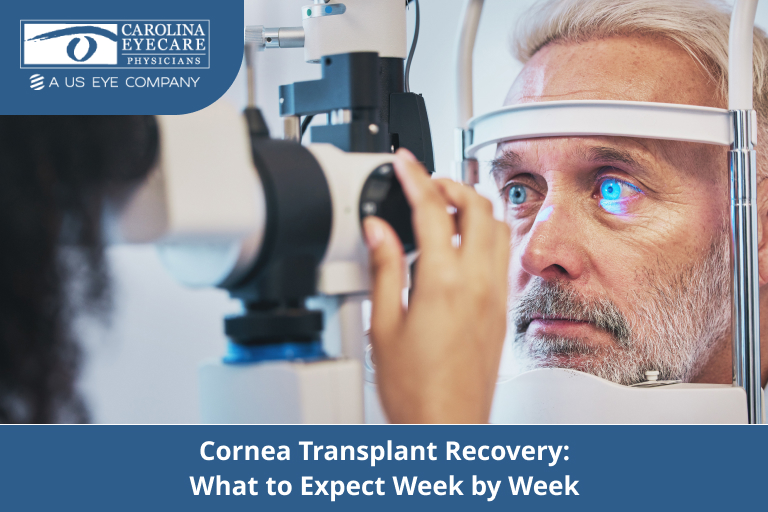
Reviewed By: Dr. Cole Miliken, MD Summary Cornea transplant recovery is gradual. Some patients notice improvement within weeks, while others need many months for vision to stabilize. The timeline depends on the type of transplant, the reason for surgery, your eye health, and how closely you follow your postoperative instructions. More than 47,000 corneal transplants […]
Read More… from Cornea Transplant Recovery: What to Expect Week by Week


We are a proud partner of US Eye, a leading group of patient-centric, vertically integrated multi-specialty physician practices providing patients with care in ophthalmology, optometry, dermatology, audiology, and cosmetic facial surgery.